
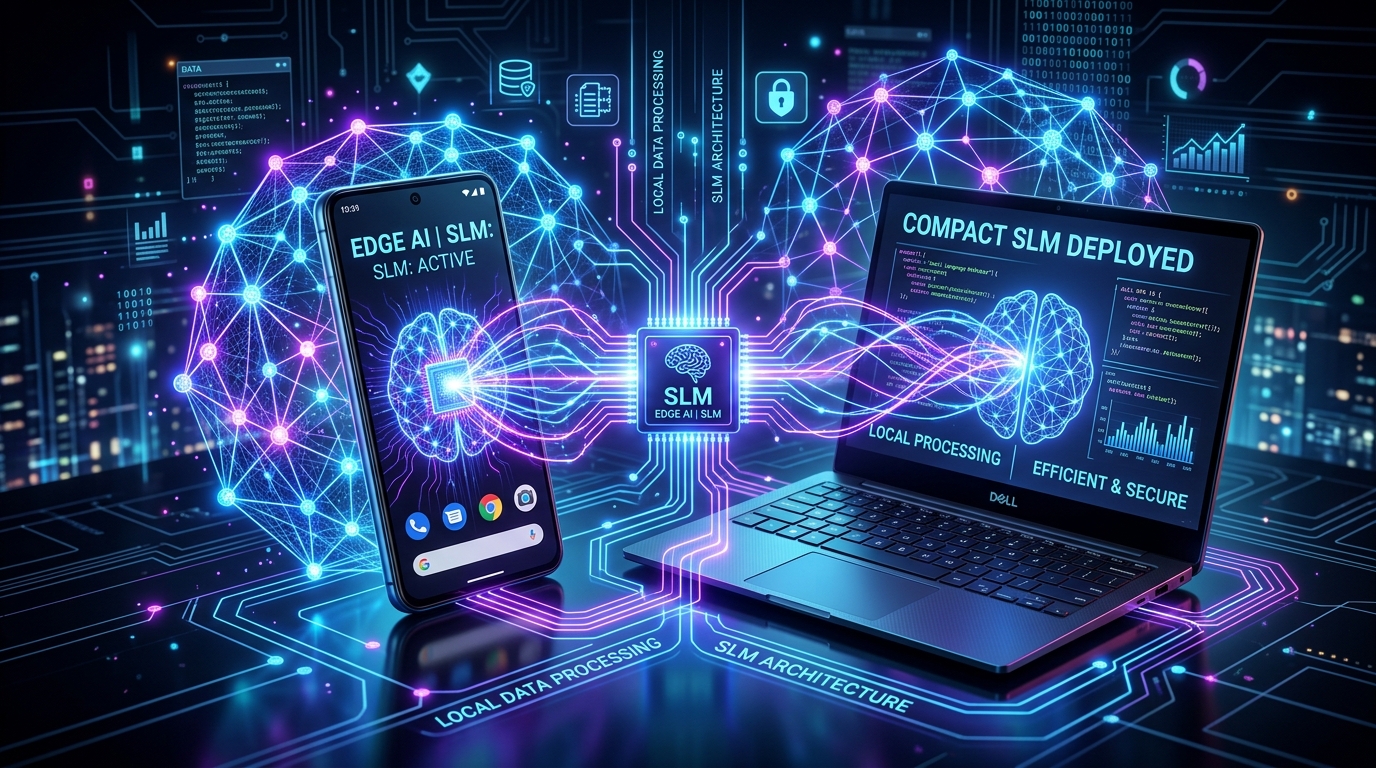
While the early era of generative AI was characterized by a race for ever-larger model sizes, the industry in 2026 has entered a pragmatic new phase. The rapid emergence of Small Language Models in 2026 (SLMs) is transforming enterprise computing by delivering specialized, on-device intelligence without the exorbitant latency, cost, and privacy vulnerabilities of multi-hundred-billion parameter giants.
1. What Are Small Language Models (SLMs)?
Unlike massive frontier models that require warehouse-scale data centers, Small Language Models in 2026 typically feature parameter counts ranging between 1 billion and 8 billion parameters. Through cutting-edge model distillation, synthetic data curation, and architectural quantization, modern SLMs match or exceed the reasoning performance of yesterday’s massive models on specific business tasks.
- On-Device Local Inference: Running entirely on local smartphone NPUs, laptops, or edge servers without transmitting sensitive data to external clouds.
- Drastically Lower Latency: Delivering sub-10 millisecond token generation for real-time customer voice agents and interactive UI tools.
- Fractional Compute Costs: Reducing operational inference expenditure by up to 90% compared to querying proprietary cloud APIs.
2. Key Architectural Advantages: SLMs vs. Giant LLMs
To understand the business appeal of Small Language Models in 2026, consider how they compare to cloud-based frontier models across critical enterprise criteria:
| Evaluation Metric | Cloud-Based Frontier LLMs | Compact Edge SLMs (2026) |
|---|---|---|
| Hardware Footprint | Multi-GPU Cloud Clusters | Local NPUs / Single Consumer GPUs |
| Inference Cost | High token-based API pricing | Fixed local hardware cost ($0/token) |
| Data Privacy | Requires external network transit | 100% On-premises zero-data retention |
| Customizability | Limited system prompt tuning | Full parameter fine-tuning (LoRA / QLoRA) |
| Response Latency | 300ms – 2,000ms network round-trip | 10ms – 50ms native local inference |
3. Practical Business Use Cases Driving Adoption
Private Enterprise Knowledge Retrieval (RAG)
Corporations deploy SLMs paired with local vector databases to query confidential legal contracts, internal HR policies, and source code repositories without exposing proprietary intellectual property to public internet servers.
Automated Customer Support Voice Agents
Voice interactions demand instantaneous turn-taking. SLMs running directly on telephony edge servers eliminate noticeable conversational lag, providing natural human-like speech synthesis.
Smart Industrial IoT and Robotics
In manufacturing plants and autonomous drones where internet connectivity may be intermittent or nonexistent, SLMs execute complex diagnostic decision trees reliably on embedded silicon.
4. Best Practices for Deploying SLMs in Your Stack
- Evaluate Task Specificity First: Reserve giant cloud LLMs for complex, open-ended creative strategy, while delegating routine classification, parsing, and structured extraction to fine-tuned SLMs.
- Utilize Modern Quantization: Modern 4-bit and 8-bit quantization frameworks preserve model accuracy while shrinking memory footprints down to standard mobile RAM limits.
- Maintain Continuous Evaluation Benchmarks: Track domain-specific accuracy regularly to detect model drift when fine-tuning on proprietary internal datasets.
Frequently Asked Questions (FAQ)
Are Small Language Models capable of coding and mathematical reasoning?
Yes. Contemporary SLMs trained on high-quality synthetic code datasets frequently outperform earlier general-purpose models on benchmark programming benchmarks such as HumanEval.
Can SLMs operate completely offline without internet?
Absolutely. One of the primary advantages of SLMs is complete offline autonomy, making them ideal for healthcare clinics, remote field stations, and privacy-sensitive mobile applications.
Conclusion
The rise of Small Language Models in 2026 proves that efficiency, privacy, and speed matter far more than sheer parameter size for real-world software. Embracing edge AI enables businesses to build faster, cheaper, and more secure intelligent applications today.