
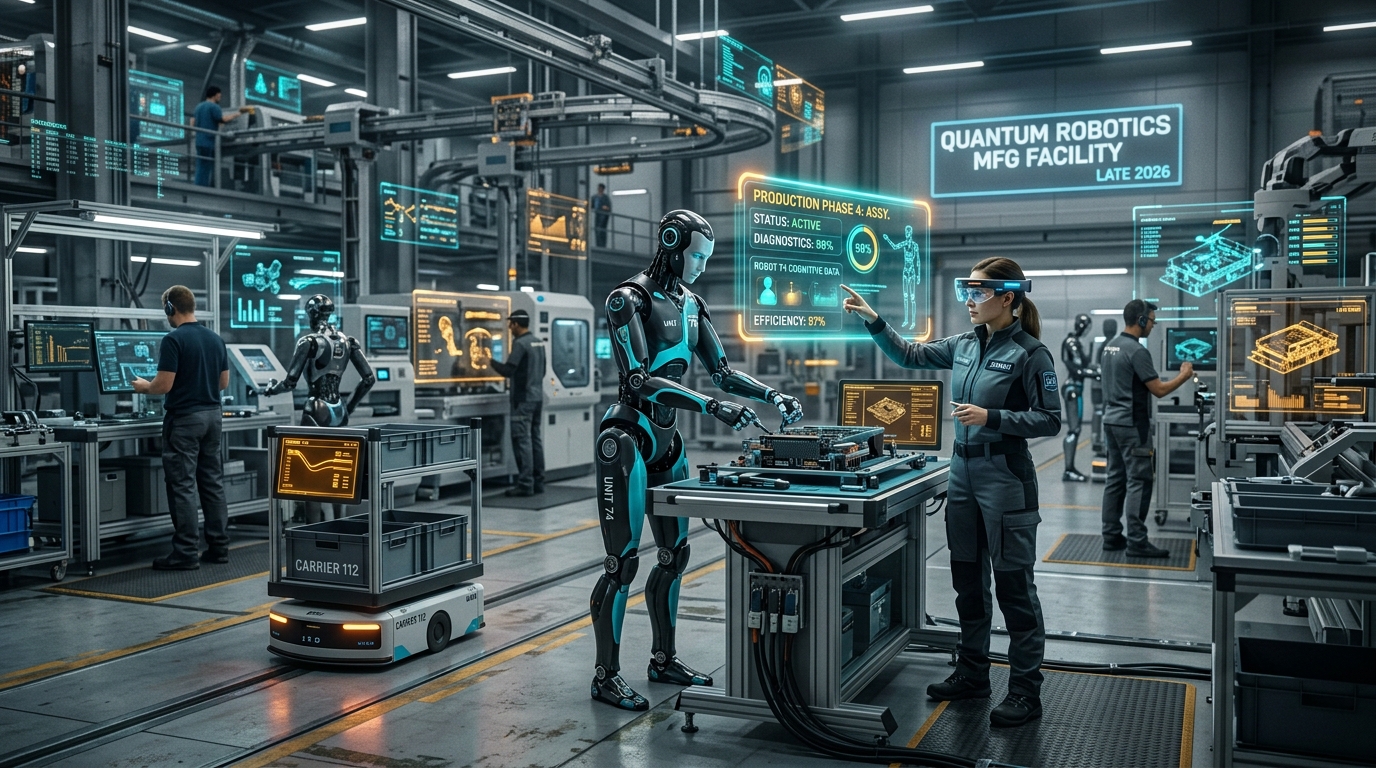
For years, generative artificial intelligence has existed primarily behind glass screens—generating synthetic code, rendering photorealistic imagery, and answering natural language prompts. However, entering the final quarter of 2026, the tech industry is experiencing its most profound hardware leap yet: the rise of Physical AI. Driven by multimodal Vision-Language-Action (VLA) foundation models and real-time spatial intelligence, autonomous bipedal humanoid robots are stepping off promotional laboratory demo stages and entering commercial assembly lines, logistics fulfillment centers, and cleanroom semiconductor packaging plants.
From Disembodied Chatbots to Embodied Foundation Models
Traditional industrial automation relied on rigid, deterministic robotic arms programmed to execute identical sub-millimeter trajectories repeatedly. Any slight anomaly—a misaligned screw, an unexpected shadow, or an obstacle in the transit path—triggered costly emergency line halts. In contrast, Physical AI equips robotic systems with continuous perceptual reasoning and spatial comprehension.
By unifying multimodal computer vision, tactile haptic feedback, and spatial proprioception within unified transformer backbones, modern robots can generalize unseen tasks on the fly. Rather than hardcoded motion coordinates, a technician can verbally instruct a robot: “Inspect the left solder joint on chassis unit 4, swap the torque bit if thermal drift exceeds 3%, and rack the finished assembly.” Understand how compact on-device architectures make low-latency robotic inference viable in our guide on Small Language Models (SLMs) and edge compute.
The Core Technological Pillars of Physical AI in 2026
The breakthrough scalability of physical humanoid systems in late 2026 rests on three synchronized technology layers:
- Vision-Language-Action (VLA) Architectures: Large multimodal models directly map visual camera streams and verbal commands into high-frequency motor torque trajectories (50Hz–200Hz control loops) without fragile intermediate symbolic translation.
- Physics-Informed Digital Twin Simulation: Millions of training iterations are conducted in GPU-accelerated synthetic physics environments (such as NVIDIA Isaac Sim and Omniverse), enabling robots to master zero-shot sim-to-real physical transfer prior to factory floor activation.
- Neuromorphic & Tactile Sensor Skins: High-density pressure sensor arrays across robotic grippers allow delicate handling of flexible wires, fragile silicon wafers, and unboxed consumer goods with human-grade dexterity.
Legacy Industrial Robotics vs. Physical AI Humanoids (2026)
| System Metric | Legacy Fixed Industrial Robots | Physical AI Autonomous Humanoids (2026) |
|---|---|---|
| Task Flexibility | Strict single-purpose deterministic loops | Generalized multi-task zero-shot adaptation |
| Safety Protocol | Caged physical isolation zones | Real-time spatial dynamic collision avoidance |
| Setup & Programming | Weeks of manual kinematic calibration | Natural language & human video demonstration imitation |
| Hardware Mobility | Bolted to floor or fixed linear gantry | Omnidirectional bipedal & wheeled agile locomotion |
| Payload & Dexterity | Heavy payload, low fine-motor adaptability | Human-scale payload (15-25kg) with adaptive tactile grip |
Key Real-World Industrial Deployments
Commercial rollouts across major industrial conglomerates are accelerating rapidly in late 2026:
- Automotive Final Assembly: Handling tedious ergonomic tasks such as underbody wire harness routing, door seal seating, and heavy battery tray alignment alongside human co-workers.
- High-Tech Electronics & Chip Packaging: Operating in Class 1 cleanrooms with zero particle contamination, transporting delicate EUV photomasks and substrate carriers between lithography modules.
- Cold-Chain Logistics Fulfillment: Working continuous 16-hour shifts in sub-zero refrigerated distribution depots, depalletizing mixed cartons without human cold-exposure risks.
To examine how verified logic guarantees zero safety violations in autonomous systems, read our analysis of Neuro-Symbolic AI and verified reasoning systems, or review the latest IEEE Robotics and Automation Society international safety standards.
Frequently Asked Questions (FAQ)
What is the primary difference between Generative AI and Physical AI?
Generative AI outputs digital tokens, text, code, audio, and visual pixels. Physical AI takes real-world multimodal perceptual inputs (cameras, LIDAR, IMU, tactile touch) and outputs continuous mechanical actions, joint angles, and motor torque to manipulate physical objects.
Are humanoid robots fully replacing human factory workers in 2026?
No. Current factory deployments focus on high-ergonomic strain, hazardous chemical exposure, repetitive lifting, and third-shift staffing shortages. Human workers are elevated to supervisory roles, overseeing fleet orchestration, exception handling, and process optimization.