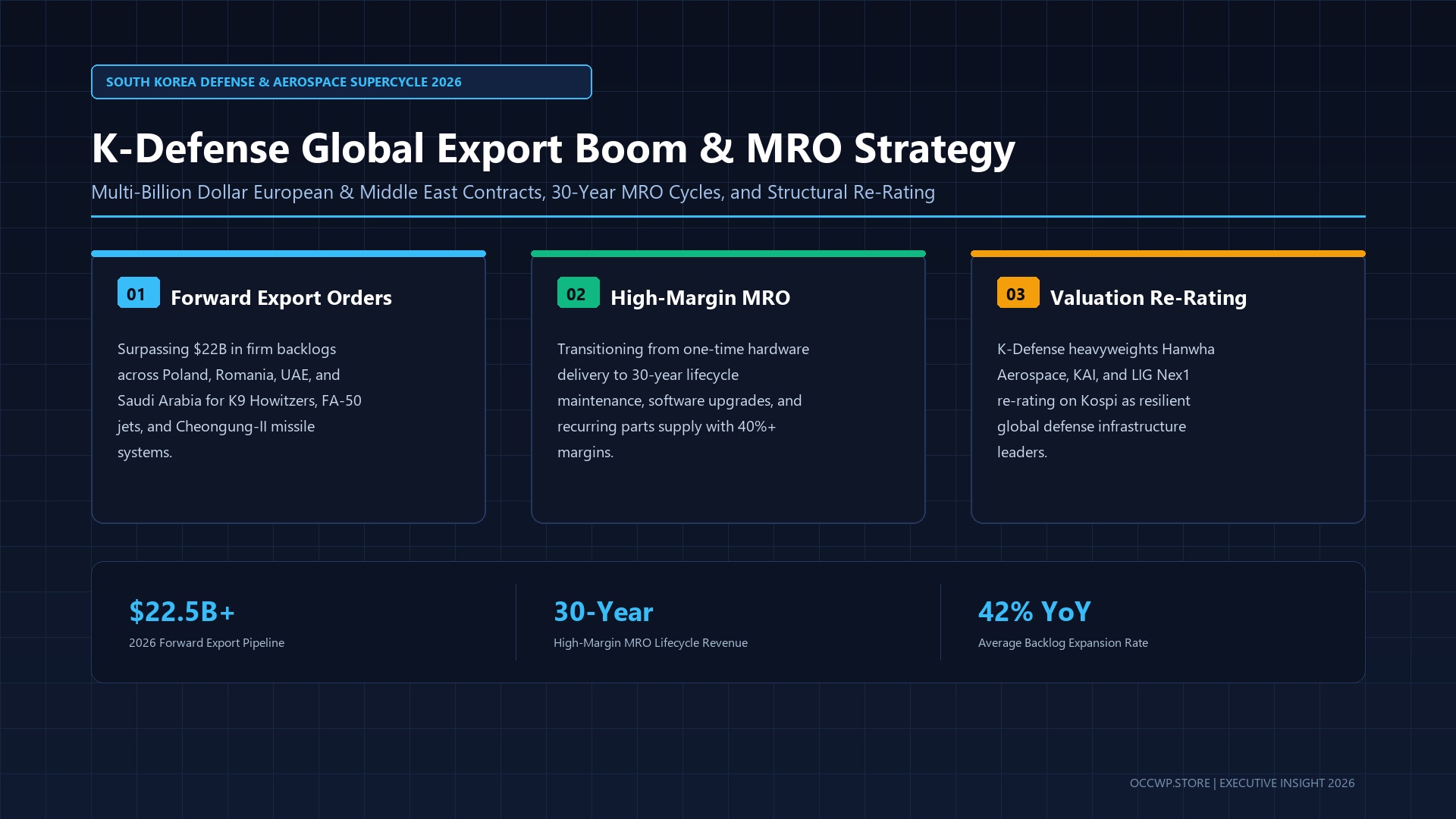
While global equity markets navigate macroeconomic crosscurrents, South Korea’s defense manufacturing sector (colloquially termed K-Defense) has firmly established itself as one of the world’s most formidable industrial exporters in late 2026. Backed by rapid delivery timelines, cost-competitive precision engineering, and NATO-interoperable platforms, domestic defense powerhouses—including Hanwha Aerospace, Korea Aerospace Industries (KAI), and LIG Nex1—have amassed historic forward order backlogs exceeding \$22 billion. Crucially, the investment thesis is transitioning from cyclical one-off hardware sales into high-margin, multi-decade MRO (Maintenance, Repair, and Overhaul) recurring revenue streams.
The Geopolitical and Industrial Catalysts of the K-Defense Supercycle
The sustained global demand for South Korean defense hardware stems from an urgent structural deficit across Western defense supply chains. Decades of European de-industrialization left conventional defense contractors incapable of delivering combat vehicles, artillery systems, and air defense batteries without multi-year lead times. In contrast, South Korea maintained hot production lines and resilient supply chains due to constant peninsular readiness requirements.
When allied nations require certified, field-proven armaments delivered within months rather than decades, Korean manufacturers provide an unmatched value proposition. Learn how corporate governance reforms are reinforcing institutional confidence across Seoul’s bourse in our breakdown of the Korea Value-Up Program and dividend growth.
Core Weapon Platforms Driving Late 2026 Export Success
- K9 Thunder 155mm Self-Propelled Howitzer: Dominating over 55% of the global tracked artillery export market, with expanded contracts across Poland, Romania, Egypt, and Australia.
- Cheongung-II (M-SAM) Surface-to-Air Missile: Securing multi-billion dollar air defense umbrella agreements throughout the UAE, Saudi Arabia, and Iraq to protect critical oil infrastructure and airspace.
- FA-50 & KF-21 Boramae Multi-Role Fighters: Capturing high-growth light combat and trainer contracts across Southeast Asia and Eastern Europe, positioning KAI as an indispensable aerospace partner.
- K2 Black Panther Main Battle Tank: Fulfilling massive European procurement schedules with deep local manufacturing partnerships and technology transfer arrangements.
Financial Structure: The High-Margin MRO Pivot
Smart institutional investors recognize that the true long-term profitability of military procurement lies not in initial airframe or chassis delivery, but in the subsequent 30-year operational lifecycle. Modern military assets generate 2.5x to 3x their initial sticker price in spare parts, avionics modernizations, munitions replenishments, and depot maintenance.
| Operational Dimension | Initial Equipment Fabrication (OEM) | Lifecycle MRO & System Upgrades (2026+) |
|---|---|---|
| Revenue Nature | One-time lumpy contract revenue | Predictable 20-30 year recurring cash flow |
| Operating Margin | 8% – 12% standard manufacturing margin | 25% – 40%+ software and proprietary component margin |
| Macro Sensitivity | Dependent on sovereign defense capex cycles | Non-discretionary operational readiness budgets |
| Contract Stickiness | Subject to competitive international tenders | Near-monopoly vendor lock-in for original manufacturer |
Stock Valuation and Institutional Capital Flows
Historically discounted under the “Korea Discount” umbrella, K-Defense equities have undergone a structural multiple re-rating throughout 2026. Institutional fund managers are treating leading defense names as defensive compounders with sovereign-backed revenue visibility extending into the 2030s. Compare this industrial resurgence with South Korea’s maritime heavy industry in our report on South Korea’s Eco-Shipbuilding Supercycle, or review defense procurement policy updates via the Defense Acquisition Program Administration (DAPA).
Frequently Asked Questions (FAQ)
Why do European nations choose Korean defense systems over domestic European options?
Speed of delivery and production scalability. Korean shipyards and defense plants maintain vertically integrated manufacturing ecosystems that can assemble and ship complete armored battalions within 6 to 12 months, whereas European counterparts often require 36 to 48 months for initial deliveries.
What are the primary investment risks facing Korean defense stocks in late 2026?
The main headwinds include raw material price inflation, geopolitical shifts in bilateral defense treaties, foreign currency exchange rate volatility, and demands for offset trade/local manufacturing concessions in purchasing countries.