As the artificial intelligence ecosystem matures in late 2026, enterprise technology teams are moving away from prompting single, monolithic models with massive context windows. Instead, industry leaders are adopting a modular agentic AI architecture—deploying fleets of specialized, task-specific sub-agents that collaborate dynamically to solve complex end-to-end problems.
Why Single Monolithic Models Hit a Ceiling
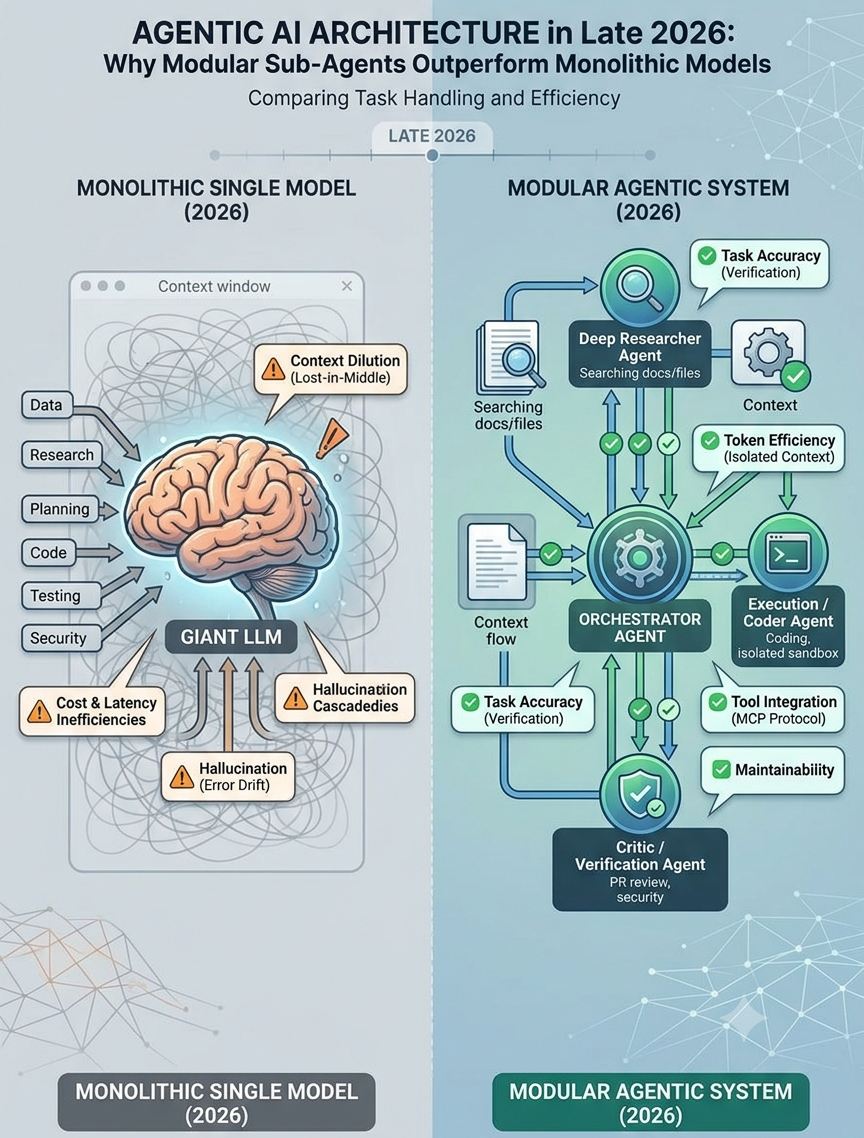
While massive foundational models possess immense general knowledge, asking a single model instance to research, plan, write code, execute tests, and perform security audits simultaneously introduces severe cognitive degradation:
- Context Dilution & Lost-in-the-Middle: Massive prompt contexts often result in models overlooking subtle constraints buried in intermediate reasoning steps.
- Hallucination Cascades: When a single model makes an early planning mistake, subsequent steps amplify the error rather than correcting it.
- Cost and Latency Inefficiencies: Routing every minor sub-task through an expensive flagship model inflates operational overhead dramatically.
Core Components of Modular Agentic AI Architecture
A resilient agentic AI architecture decomposes workflows into distinct functional nodes, governed by robust protocols like Model Context Protocol (MCP):
- Orchestrator Agent: Evaluates incoming user intent, determines dependencies, and dynamically spawns specialized sub-agents.
- Deep Researcher Agent: Scans technical documentations, indexes local file repositories, and synthesizes architectural constraints.
- Execution / Coder Agent: Operates in an isolated sandbox environment, writing modular code and executing unit tests.
- Critic / Verification Agent: Inspects intermediate pull requests and verifies compliance against established security standards before user review.
Monolithic LLM vs. Modular Agentic System Comparison
| Evaluation Dimension | Monolithic Single Model | Modular Agentic Architecture |
|---|---|---|
| Task Accuracy | Prone to error drift on long tasks | High verification via specialized sub-agents |
| Token Efficiency | Transfers full history on every call | Isolated context per specialized agent node |
| Tool Integration | Complex monolithic function calling | Dedicated MCP tool groups per agent |
| Maintainability | Brittle single-prompt engineering | Modular, inspectable agent system prompts |
Frequently Asked Questions (FAQ)
What is the primary advantage of agentic AI architecture?
Modularity. Each sub-agent operates with clean, focused context and specialized tool permissions, resulting in vastly higher reliability and lower token consumption.
How do sub-agents communicate with each other?
Agents communicate via structured JSON messaging schemas and shared memory vector databases, allowing asynchronous handoffs between planning and execution layers.