Managing an investment portfolio in 2026 demands a disciplined, adaptive approach. Between shifting global interest rate cycles and ongoing macroeconomic adjustments, successful investors rely on strategic asset allocation to protect capital while capturing sustainable long-term growth.
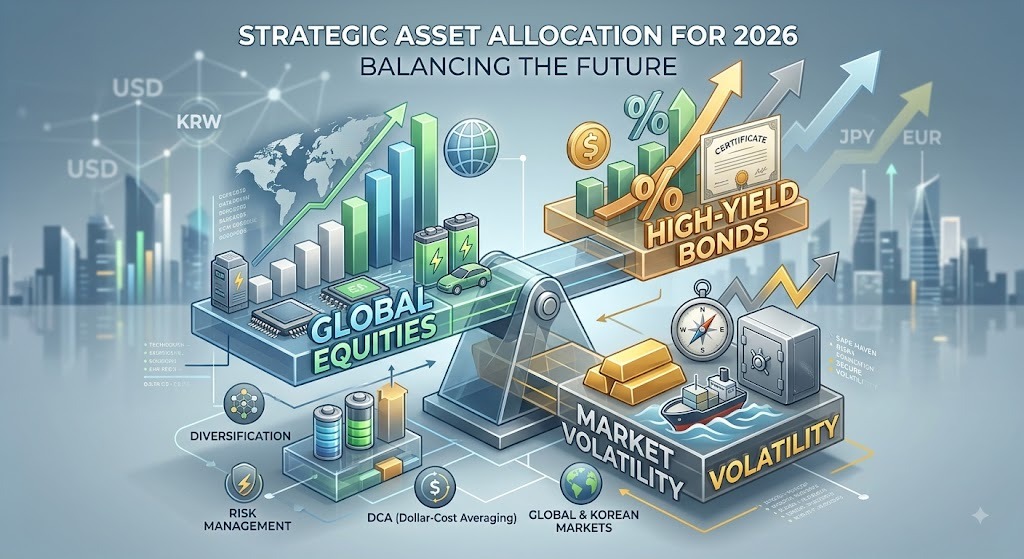
The Core Pillars of Strategic Asset Allocation
According to modern portfolio theory published on Investopedia, strategic asset allocation remains the single most influential determinant of overall portfolio returns and risk tolerance. A robust 2026 portfolio balances four core building blocks:
- Core Growth Equities (45% – 55%): Global index ETFs, broad-market domestic leaders, and quality dividend compounders that provide inflation-beating long-term appreciation.
- Fixed Income & Yield Instruments (25% – 35%): High-grade corporate debt, sovereign treasury bonds, and short-duration cash equivalents that generate stable cash flow and anchor portfolio stability.
- Defensive Real Assets (5% – 10%): Gold, infrastructure investment trusts (InvITs), and select commodities that offer low correlation to traditional equities during geopolitical tension.
- Tactical Opportunity Cash (5% – 10%): Highly liquid high-yield savings or money market funds ready to capitalize on short-term market pullbacks.
Navigating Global Markets with Strategic Asset Allocation
Investors focused on global markets and South Korea face unique opportunities in 2026. The continued expansion of global semiconductor supercycles and tech innovation (such as autonomous AI agents and technology trends) has revitalized core industrial sectors. However, careful risk mitigation is essential:
- Dollar Hedging vs. Won Diversification: Holding a portion of liquid assets in US Dollar-denominated ETFs provides a natural hedge against domestic currency fluctuations. For beginner ETF strategies, check out our Beginner’s Guide to ETF Investing in Korea.
- The Dividend Growth Advantage: Enhanced corporate governance standards and value-up initiatives have made high-dividend yield stocks an increasingly reliable income stream for retail investors.
- Low-Cost Index Funds: Minimizing expense ratios through broad-market ETFs ensures compounding gains remain in your portfolio.
The Role of Dollar-Cost Averaging in Strategic Asset Allocation
Attempting to predict short-term market tops and bottoms is statistically a losing game. The most reliable pathway to wealth accumulation within a strategic asset allocation plan remains disciplined dollar-cost averaging (DCA):
- Automate Your Contributions: Set recurring weekly or monthly investments regardless of daily market headlines.
- Rebalance Semi-Annually: If equity outperformance skews your target allocation, trim gains to reinvest in undervalued asset classes.
- Avoid Emotional Panic Selling: Historical market cycles consistently demonstrate that steep market corrections often precede the strongest recovery rallies.
Strategic Asset Allocation Comparison Summary
Here is how a balanced strategic asset allocation framework aligns with different investor risk profiles in 2026:
| Investor Profile | Equities (%) | Fixed Income (%) | Cash / Gold (%) | Primary Objective |
|---|---|---|---|---|
| Aggressive Growth | 75% | 15% | 10% | Maximum Long-Term Capital Gains |
| Balanced Wealth Builder | 55% | 35% | 10% | Consistent Growth with Controlled Risk |
| Capital Preservation | 30% | 55% | 15% | Stable Passive Income & Low Volatility |
Frequently Asked Questions (FAQ)
How often should I adjust my strategic asset allocation?
A semi-annual or annual rebalance schedule is ideal. Rebalancing too frequently creates unnecessary trading friction and tax overhead.
Is strategic asset allocation suitable for beginners?
Yes, strategic asset allocation is the foundational strategy recommended by financial economists worldwide because it minimizes emotional trading and maximizes long-term compounding.