
The artificial intelligence landscape has undergone a monumental shift. In previous years, AI was primarily viewed as a conversational assistant. As we navigate 2026, the paradigm has decisively shifted toward autonomous AI agents and collaborative multi-agent systems capable of reasoning, planning, and executing complex workflows with minimal human oversight.
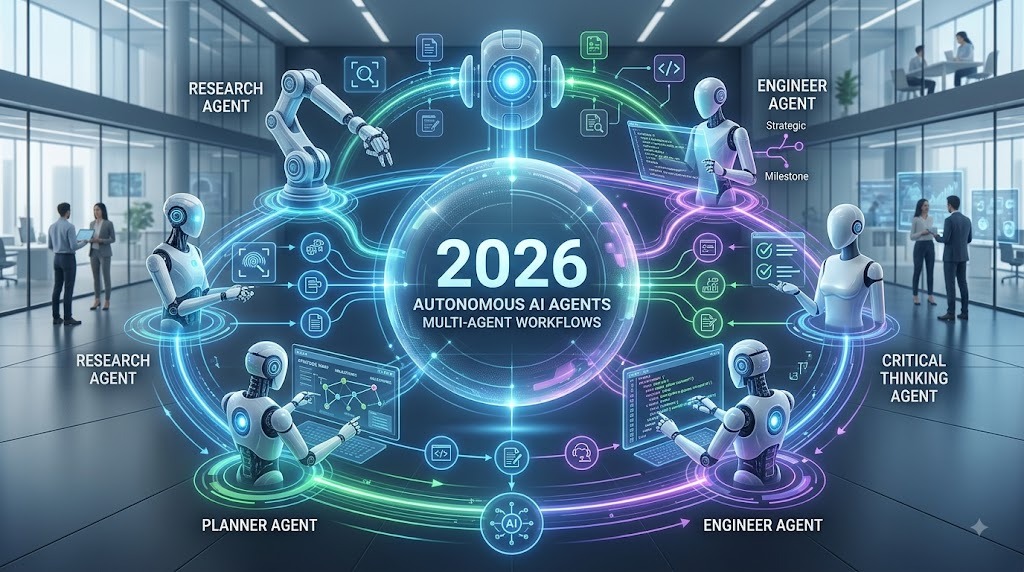
From Passive Chatbots to Autonomous AI Agents
Traditional large language models operate on a single input-output cycle. While powerful, they lack persistent context. In contrast, modern autonomous AI agents are equipped with several critical architectural components:
- Planning & Decomposition: The ability to break down a high-level goal into actionable, sequential sub-tasks.
- Tool Usage & API Integration: The agency to browse the web, execute terminal commands, query databases, and manipulate local files via protocols like Model Context Protocol (MCP).
- Short-term & Long-term Memory: Vector-based memory systems that allow autonomous AI agents to retain project state and past learnings across extended sessions.
- Self-Correction & Reflection: The capacity to inspect task output, evaluate errors, and refine strategies iteratively before delivering results.
The Power of Multi-Agent Collaboration in Autonomous AI Agents
Rather than relying on a single monolithic model to solve multidisciplinary challenges, modern engineering organizations are deploying specialized agent swarms. In a typical software development pipeline, multiple specialized autonomous AI agents collaborate in tandem:
1. The Researcher Agent: Scans technical documentation, analyzes dependencies, and maps out architectural requirements.
2. The Planner Agent: Establishes step-by-step implementation milestones and verification criteria.
3. The Engineer Agent: Writes modular, clean code and updates project configuration.
4. The QA / Reviewer Agent: Executes test suites, identifies security vulnerabilities, and optimizes performance bottlenecks.
Key Business Applications of Autonomous AI Agents in 2026
The economic impact of autonomous AI agents is already tangible across key global sectors:
- Autonomous Customer Operations: Customer service agents resolve tier-2 inquiries end-to-end, issuing refunds and updating internal records.
- Automated Market Intelligence: Financial agents ingest global economic news and SEC filings to generate comprehensive equity research briefs in minutes. For more on smart finance strategies, explore our Strategic Asset Allocation Guide for 2026.
- Self-Healing Cloud Infrastructure: DevOps agents detect server latency anomalies and deploy targeted microservice patches automatically. Learn more about core infrastructure in our guide to cloud computing.
Best Practices for Implementing Autonomous AI Agents Safely
To safely unlock the full potential of agentic workflows while maintaining governance, technology leaders must observe three fundamental principles:
- Enforce Human-in-the-Loop Safeguards: High-stakes actions, such as production database migrations or financial disbursements, should always require explicit user approval.
- Maintain Sandbox Environments: Run agent-driven command line operations and code executions within isolated containers to protect core infrastructure.
- Establish Observable Logging: Monitor trajectory logs, API token consumption, and intermediate tool call results according to established artificial intelligence engineering standards.
Frequently Asked Questions (FAQ)
Will autonomous AI agents replace human developers and analysts?
Autonomous AI agents augment human capability rather than replacing core strategic thinking. They eliminate repetitive boilerplate tasks, allowing professionals to focus on high-leverage architectural and creative decisions.
What frameworks are leading autonomous AI agents development in 2026?
Open-source frameworks like LangGraph, AutoGen, and modern MCP tool integrations are currently the standard for building enterprise agent ecosystems.