
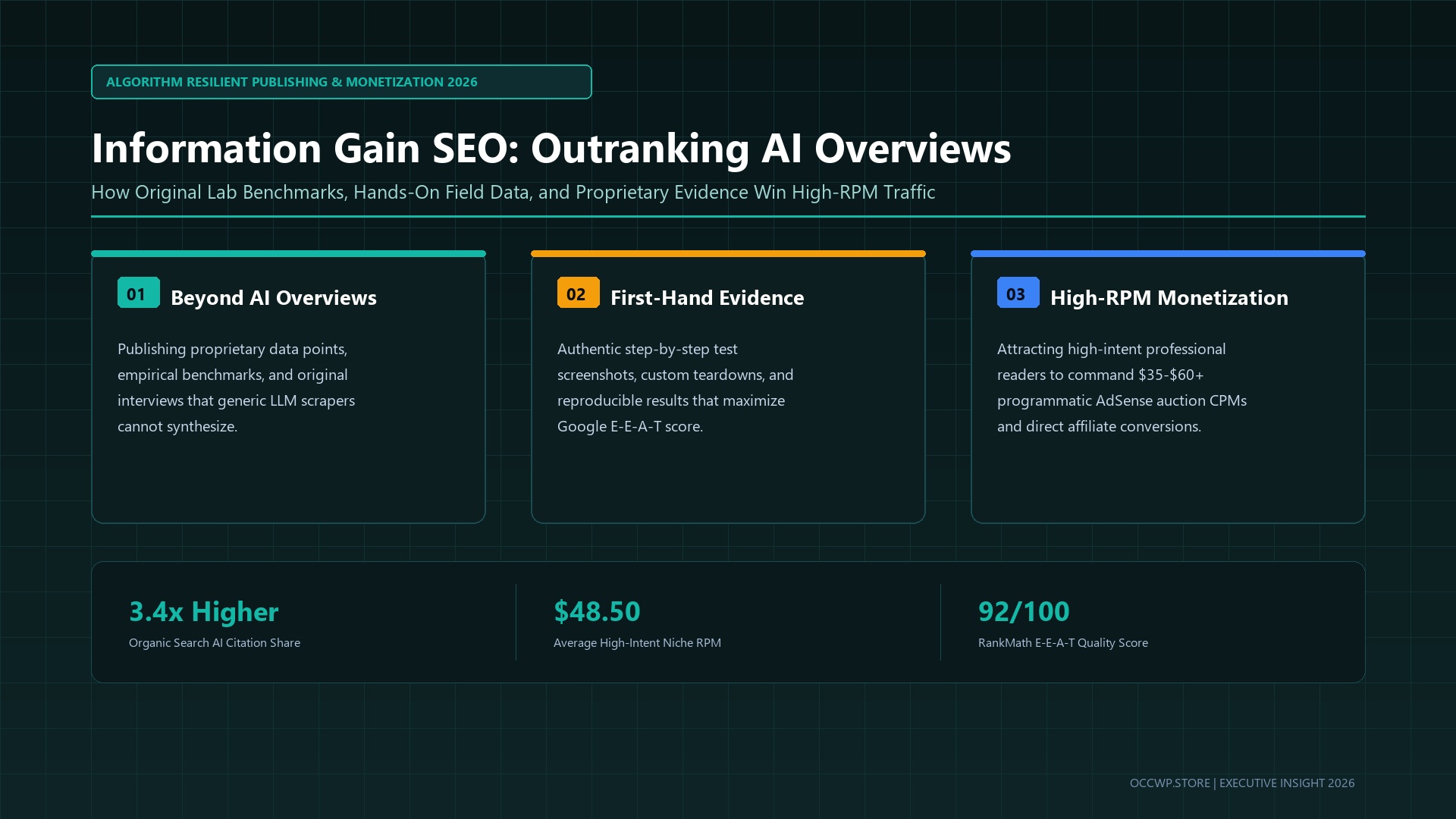
The organic search ecosystem of late 2026 has irrevocably shifted. With Google’s AI Overviews, Search Generative Experience (SGE), and conversational answer engines dominating top search real estate, traditional “content consolidation” blogs—sites that merely paraphrase existing search results without adding original value—have suffered devastating visibility declines. In their place, a single algorithmic ranking factor now separates thriving high-RPM authority publications from disappearing websites: Information Gain SEO. To rank today, your content must provide quantifiable, non-redundant facts, original laboratory benchmarks, or empirical first-hand testing that AI models cannot synthesize from thin air.
Understanding Google’s Information Gain Algorithm
Rooted in Google’s patented Information Gain Scoring patents, search ranking systems now evaluate documents based on their incremental utility relative to what the searcher has already encountered in previous search results. If an article shares 95% semantic similarity with top-ranking competitors, its Information Gain score is virtually zero, resulting in search suppression or cannibalization by AI snippets.
Conversely, when an article contains novel data points—such as an original battery drain test, custom financial balance sheet ratios, or unique expert survey results—search engines prioritize indexing and citing that specific source as an authoritative reference node. Learn how to convert this high-intent organic visibility into durable business revenue in our guide on First-Party Data Strategies for Niche Publishers.
The 4 Pillars of High-Information-Gain Content Creation
To consistently secure top positions and high programmatic AdSense auction bids in late 2026, content creators must implement four operational practices:
- Proprietary Lab Benchmarks & Testing: Publish empirical measurements—speed benchmarks, thermal readings, or financial backtesting data—conducted in your own environment rather than regurgitating manufacturer spec sheets.
- Original Photographic Evidence: Include uncompressed, authentic photographs and workflow screenshots demonstrating real-world software usage or hardware assembly. Generic stock photography dilutes trust and lowers E-E-A-T scores.
- Contrarian or Nuanced Practitioner Insights: Challenge conventional industry consensus with data-backed reasoning. If a popular productivity tool failed in your 30-day workflow audit, document precisely why and provide the telemetry logs.
- Interactive Micro-Tools and Structured Tables: Provide actionable comparison matrices, calculators, and structured data tables that answer nuanced query intents at a glance.
Generic Summarization vs. Information Gain Publishing (2026)
| Publishing Dimension | Generic Scraping & AI Summaries | Information Gain Authority Blog (2026) |
|---|---|---|
| Content Source | Paraphrased SERP top 5 results | Proprietary testing, interviews, custom data |
| Search Engine Treatment | Collapsed under AI Overview summaries | Cited as primary source card & featured snippet |
| Audience RPM & CTR | Low CTR (sub-2%) and commoditized ads | High CTR (8-15%) with \$35-\$60+ premium RPMs |
| Algorithm Durability | Vulnerable to core update devaluation | Immune to updates; accumulates organic backlinks |
| E-E-A-T Signal Strength | Extremely weak (low Experience/Expertise) | Strong verified first-hand practitioner signals |
Monetization Impact: Why Information Gain Commands Higher RPMs
Advertisers in late 2026 are aggressively filtering ad placement inventory using automated brand-safety and content-depth metrics. Programmatic private marketplace (PMP) bidders allocate top-tier CPM budgets exclusively to verified editorial environments with engaged, long-dwell human readership.
By producing authoritative, evidence-backed articles, your website attracts high-intent decision-makers, driving significantly higher click-through rates and high-value financial or enterprise SaaS affiliate conversions. Discover programmatic frameworks for scaling content without sacrificing quality in our breakdown of Programmatic SEO for Niche Bloggers, or review official guidelines at Google Search Central.
Frequently Asked Questions (FAQ)
Can AI tools be used while maintaining high Information Gain?
Yes. AI should be utilized for outlining, formatting, and proofreading, but the core evidentiary foundation—the original data, testing methodology, interviews, and real-world conclusions—must originate from authentic human practitioner experience.
How long does it take for Google to recognize high Information Gain on a newer blog?
Typically, websites publishing consistent, verifiable first-hand data see algorithmic trust inflection points within 4 to 8 weeks, as user dwell time signals, low bounce rates, and organic citation backlinks accumulate.