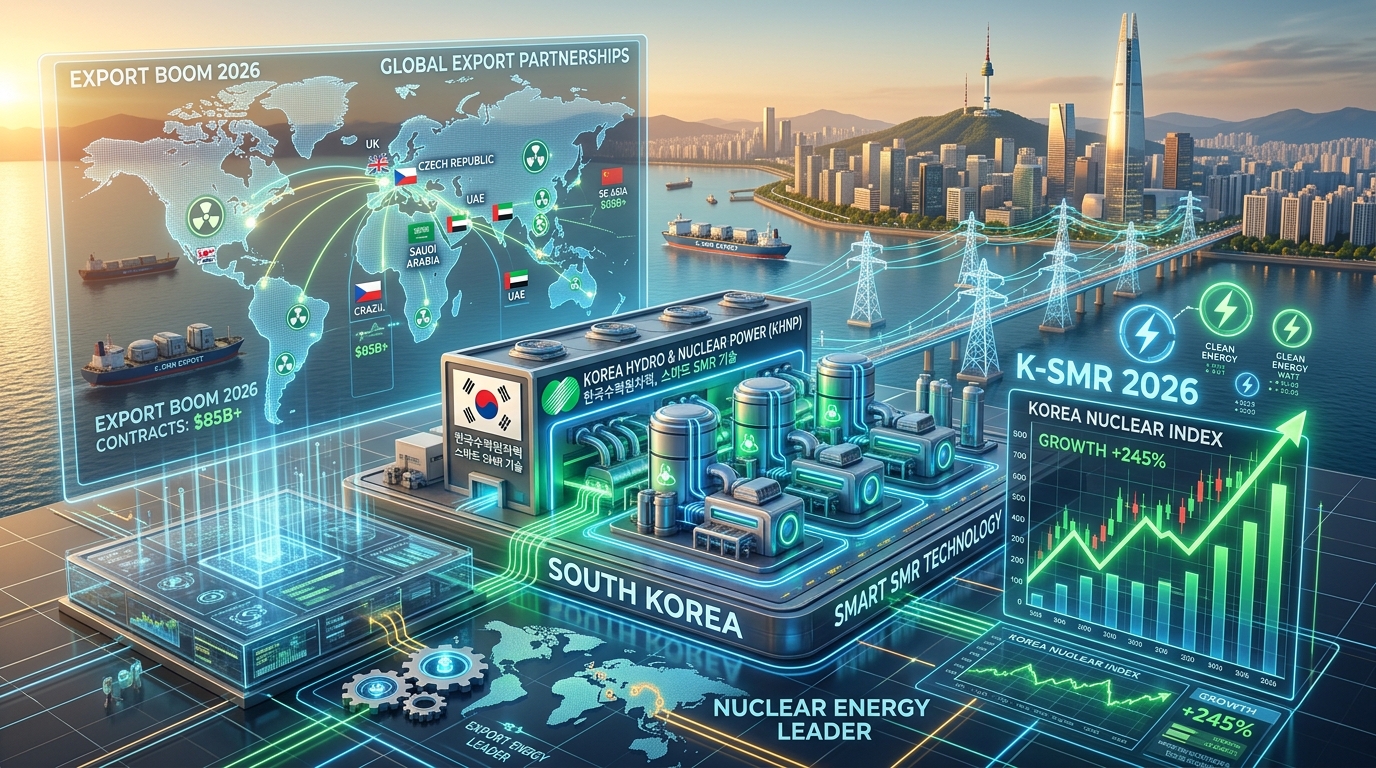
As the exponential growth of artificial intelligence data centers and industrial electrification triggers an unprecedented global power crunch in late 2026, clean baseload electricity has become the ultimate strategic commodity. South Korea’s nuclear engineering sector has seized this global inflection point, launching a multi-decade nuclear energy export supercycle driven by landmark European mega-contracts, Small Modular Reactor (SMR) breakthroughs, and massive power grid infrastructure investments.
The Drivers Behind Korea’s Historic Nuclear Export Supercycle
Unlike Western competitors that have suffered decades of supply chain atrophy, construction delays, and massive cost overruns, the South Korean nuclear consortium led by Korea Hydro & Nuclear Power (KHNP) possesses a proven track record of delivering advanced APR1400 reactors strictly “On Time and Within Budget.”
- The European Renaissance (Czech & Polish Expansions): Finalized multi-billion dollar commercial contracts across Central Europe have firmly established South Korea as Europe’s premier non-Russian nuclear construction partner.
- The AI Hyperscaler Energy Crunch: Global tech conglomerates are directly contracting nuclear power plants and dedicated SMR clusters to power gigawatt-scale AI computing campuses around the clock.
- Standardized Turnkey Construction Ecosystem: Seamless integration between state engineering design, heavy forging leaders (Doosan Enerbility), and tier-1 EPC contractors ensures unrivaled global cost competitiveness.
The SMR (Small Modular Reactor) Technological Moat
Beyond traditional 1,400MW gigawatt reactors, South Korea is rapidly commercializing standardized Small Modular Reactors (SMRs). SMRs offer several distinct financial and operational advantages:
- Factory-Built Modularity: Fully assembled in domestic fabrication shipyards and transported via standard cargo vessels, shortening on-site deployment schedules from 8 years to under 36 months.
- Passive Inherent Safety Systems: Gravity-driven natural circulation emergency cooling systems eliminate the risk of core meltdowns even during complete electrical grid station blackouts.
- Distributed Edge Proximity: SMRs can be deployed directly adjacent to major industrial chemical parks, hydrogen production hubs, and semiconductor clusters. Learn more about regional tech synergies in our analysis of Korea’s semiconductor supercycle and memory market.
Nuclear Sector Investment Allocation Framework
Investors seeking balanced exposure to this long-term industrial re-rating should examine the entire supply chain pyramid:
| Supply Chain Tier | Representative Core Competency | Strategic Investment Rationale |
|---|---|---|
| Reactor Heavy Forging | Ultra-large pressure vessel forging & turbines | Near-monopoly status in global large-scale reactor fabrication |
| EPC Construction Leaders | Turnkey nuclear power plant civil engineering | Record multi-year order backlog with predictable operating cash flows |
| Instrumentation & SMR Components | High-precision containment & coolant valves | High-margin proprietary IP with rapid SMR transition potential |
| Power Transmission & Grids | High-Voltage Direct Current (HVDC) cable links | Critical infrastructure required to transmit offshore power to cities |
Macroeconomic Synergies with Corporate Governance Reforms
The nuclear energy export supercycle aligns directly with South Korea’s broader financial capital reforms. Industrial powerhouses in the heavy engineering sector have actively adopted higher dividend distributions and capital efficiency benchmarks under the Korea Value-Up Program, making domestic energy constituents prime candidates for long-term compounding portfolios.
Frequently Asked Questions (FAQ)
How long is the typical lifecycle of a Korean-built nuclear reactor?
APR1400 reactors are certified for an initial 60-year operational lifespan, with many modern facilities designed for license extensions exceeding 80 years of reliable baseload generation.
Does nuclear energy qualify as clean energy under global ESG standards?
Yes. The European Union Taxonomy and South Korea’s K-Taxonomy officially classify nuclear power as sustainable green transition energy, enabling green bond financing.