As global demand for specialized AI hardware accelerates into the second half of 2026, South Korea’s financial markets are being propelled by a historic semiconductor supercycle. With High Bandwidth Memory (HBM4) transitions and advanced packaging taking center stage, semiconductor leaders and their domestic supply chain ecosystems are driving unprecedented export growth.
Key Drivers of the 2026 Semiconductor Supercycle
Unlike previous memory cycles driven primarily by consumer electronics, the 2026 momentum is backed by sustained hyperscaler capital expenditure and edge AI infrastructure:
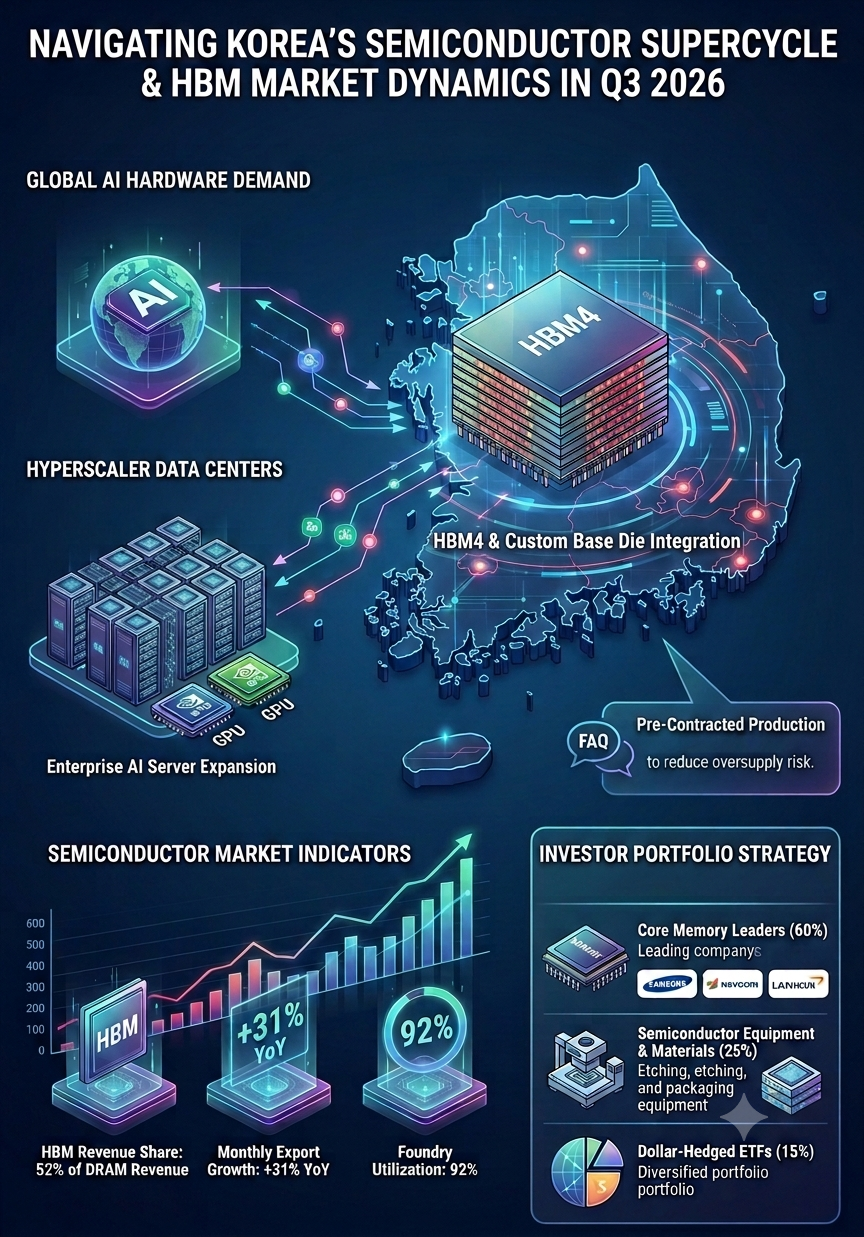
- HBM4 & Custom Base Die Integration: The shift to 16-high stacked HBM4 architectures has established massive technological moats for leading Korean memory manufacturers.
- Enterprise AI Server Expansion: Global tech giants continue to expand multi-cluster data centers, requiring unprecedented memory bandwidth per GPU.
- Domestic Value-Up Policy Tailwinds: Enhanced corporate dividend payouts and treasury share cancellations have made Korean tech giants increasingly attractive to global institutional capital.
Strategic Portfolio Positioning for Investors
To capture upside while managing cyclical risk, investors should implement disciplined allocation strategies:
- Core Memory Leaders (60%): Anchoring positions in top-tier integrated device manufacturers with dominant global market share in HBM.
- Semiconductor Equipment & Materials (25%): Selective exposure to specialized domestic packaging, etching, and thermal management suppliers.
- Dollar-Hedged ETFs (15%): Utilizing currency-hedged tech ETFs to insulate returns against foreign exchange fluctuations. For broader portfolio balance, consult our Strategic Asset Allocation Guide for 2026.
Semiconductor Supercycle Market Indicators
| Metric Indicator | H1 2026 Baseline | Q3 2026 Projection | Strategic Impact |
|---|---|---|---|
| HBM Revenue Share | 38% of DRAM Revenue | 52% of DRAM Revenue | Substantial margin expansion |
| Monthly Export Growth | +22% Year-over-Year | +31% Year-over-Year | Current account surplus support |
| Foundry Utilization | 78% | 92% | Broad supply chain recovery |
Frequently Asked Questions (FAQ)
Is the current semiconductor supercycle vulnerable to sudden oversupply?
Because HBM manufacturing requires specialized, customized customer validation cycles, production is largely pre-contracted 12 to 18 months in advance, minimizing sudden oversupply risks compared to legacy commodity DRAM.